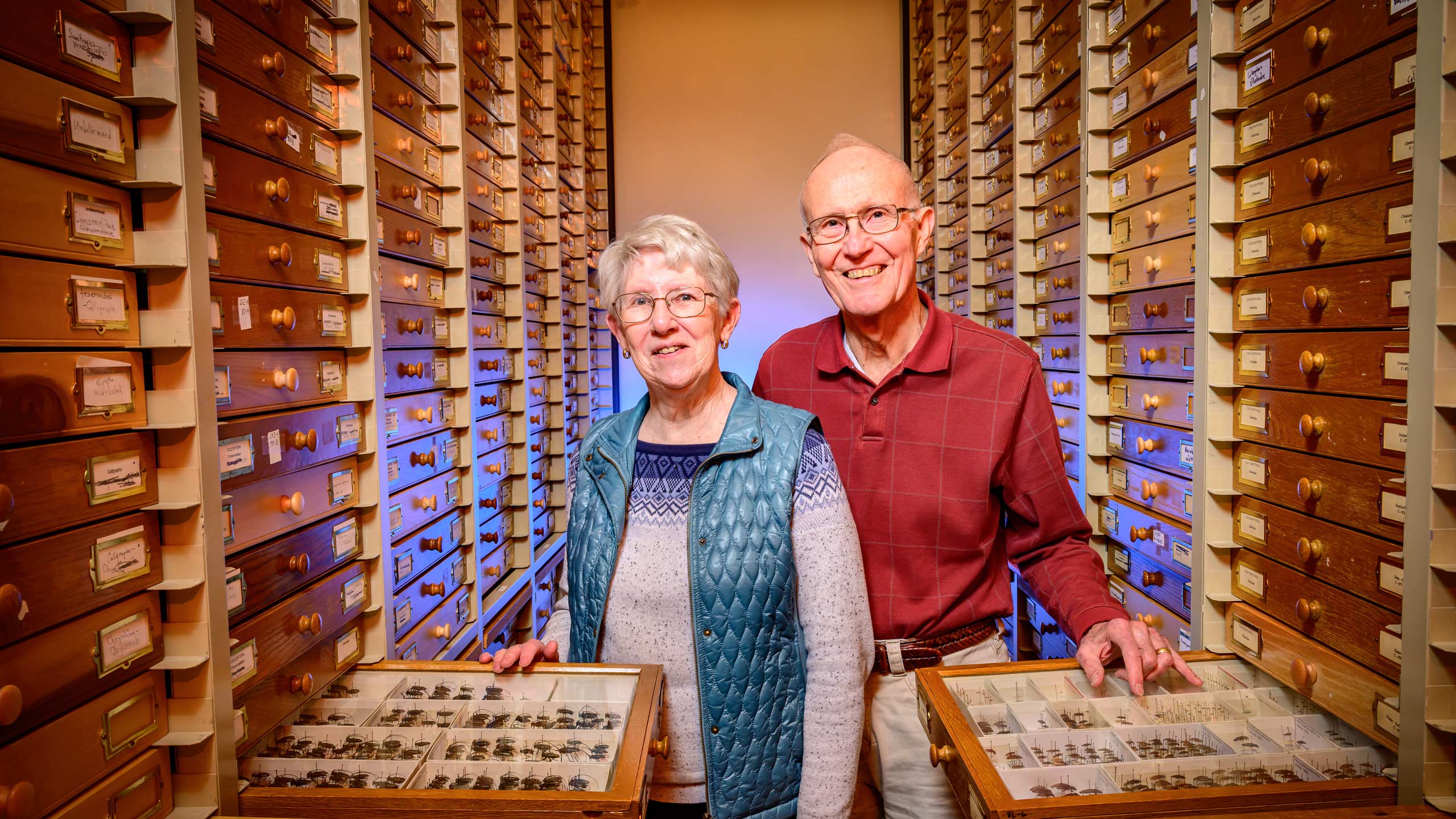
Drawer by Drawer
Bill & Cindy Ruesink’s Commitment to the INHS Insect Collection
What began as volunteer work became something more: a family commitment to preserve one of North America’s oldest and largest insect collections.
On an unseasonably warm day in March, William “Bill” and Cindy Ruesink arrived at the Natural Resources Building on the University of Illinois Urbana-Champaign campus — a 400-mile round-trip journey they have been making regularly from their home in Chesterfield, Missouri, over the last year. Unloading their car, Bill brought out four wooden drawers, each containing hundreds of individual specimens of leaf beetles he had borrowed from the Illinois Natural History Survey to identify.
Michelle Kohler, assistant manager of the insect collection, was waiting to greet them and receive the beetles. Behind her was a new stack of drawers for Bill and Cindy to take home, continuing a loop.
For Bill, each visit to the collection is a return to familiar ground.
Bill Ruesink holds a pinned Omcerus sp. leaf beetle from Costa Rica. Image by Fred Zwicky, University of Illinois.
He and Cindy spent part of their careers at the U. of I. and in the Champaign County area, starting in the 1970s. Cindy honed her skills as a weaver, making dollhouse rugs, and Bill was an entomologist and assistant director for planning at INHS, as well as a professor in the entomology department — a time he referred to as “ancient history.” They raised three kids in Mahomet, just outside of Champaign.
“We make a good team,” Cindy said. “I do liberal arts, and our kids got a good balance. We have a lot in common because I collect miniatures, and so does he.”
Despite moving away after retirement in 2003, Bill returned to volunteer in the collection. By 2008, he had begun the work that would define his relationship with the collection for years.
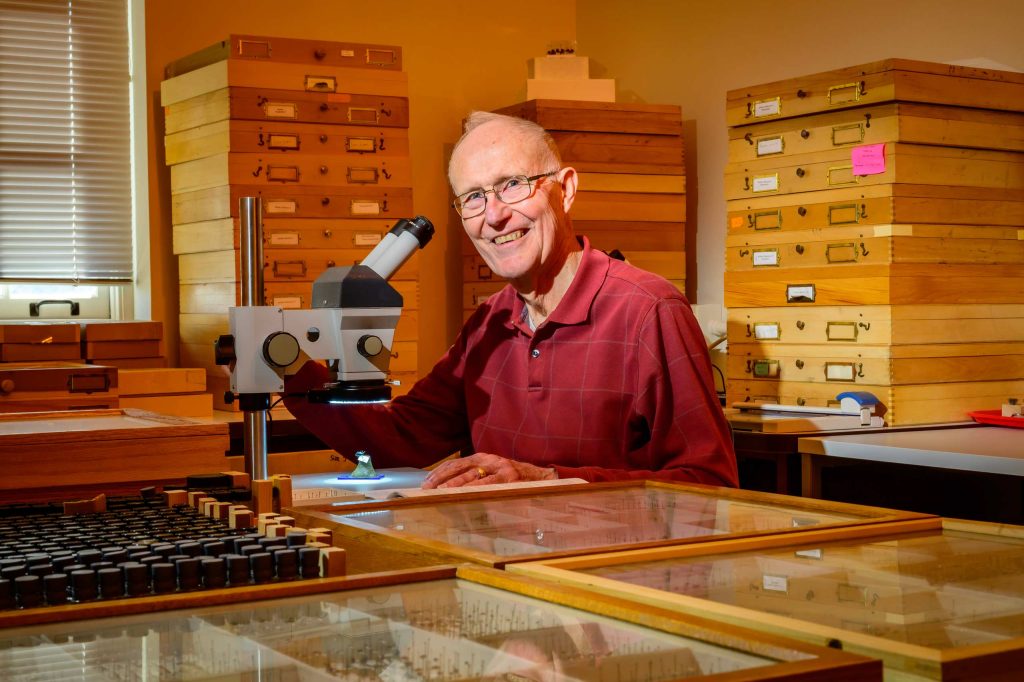
Bill Ruesink identifying beetles. Image by Fred Zwicky, University of Illinois.
“When I started seriously volunteering in 2008, the collection really needed help to organize nearly 100 drawers of unsorted beetles and identify them to the family level,” Bill said.
Thousands of beetles sat in drawers without identification or complete data, so scientists could not find or use them. Identifying each beetle turns each specimen into a data point, linking it to a time, place, and ecological history.
Beetle by beetle and drawer by drawer, Bill expanded the data available in the insect collection over several years until they moved to Michigan in 2020.
Michelle added, “That huge undertaking was impactful on how we organize the beetles in the collection today.”
Bill Ruesink looking at a drawer of beetles in the Illinois Natural History Survey Insect Collection. Image by Fred Zwicky, University of Illinois.
The insect collection at INHS is one of the largest in North America, with more than seven million specimens, and one of the oldest, with many insects dating to the late 1800s. Bill sees that history as one of the collection’s greatest strengths.
Later, the couple moved to Missouri, where they currently live. Bill returned to the collection and began identifying beetles down to the species level, starting with the long-horned beetles and moving on to leaf beetles, a group he is currently working through. At home, he re-verifies each specimen’s identification, since many specimens have been in the collection for decades — or even a century or more.
“I enjoy it,” Bill said. “It keeps my mind sharp.”
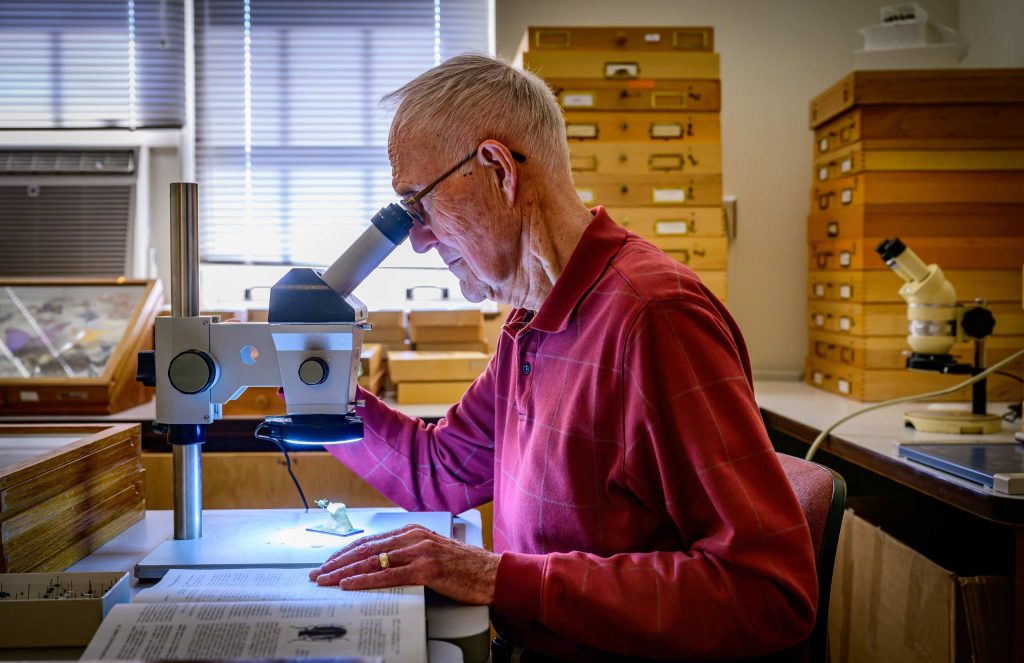
Bill Ruesink at the microscope. Image by Fred Zwicky, University of Illinois.
The scope of Bill’s work is difficult to quantify, but the collection staff know it is substantial.
“We don’t have exact numbers of how many individual beetles Bill has worked on,” Michelle said. “We know it’s massive if you consider there could be anywhere from 100 to 1,000 specimens in a single drawer.”
Bill knows North American leaf beetles well from his time researching agricultural pests. The leaf beetle family, Chrysomelidae, is one of the largest beetle families in the world, with more than 35,000 described species. Among them are two familiar crop pests: the western corn rootworm (Diabrotica virgifera virgifera) and the Colorado potato beetle (Leptinotarsa decemlineata).
Bill looked down at one drawer of leaf beetles he brought up from his car. “Some of these beetles I had collected and deposited when I worked here,” he said. “Others were collected here in Illinois by Stephen Forbes, director of INHS, over a hundred years ago, and others were collected more recently by [Illinois State Entomologist] Chris Dietrich on a trip to Kyrgyzstan.”
A pinned leaf beetle, Metopoceris gemmans, from Mexico. Image by Fred Zwicky, University of Illinois.
From Volunteers to Donors
After years of working closely with collection staff, the Ruesinks decided to do more than volunteer. With the encouragement of their three adult children, they established a $100,000 endowment to support the insect collection.
“This is our first big donation,” Bill said. “It feels like we are supporting something that needs to be done. The collection has a need, and we can help.”
The gift will help improve collection facilities and operations, support the long-term preservation of its specimens, and fund hourly wages for staff to identify, sort, and database specimens — work that is critical to making the data accessible to scientists around the world.
With their gift, the beetles Bill has worked with over the last two decades can be passed on to staff who can add them to the database for other scientists to access.
For the Ruesinks, this gift is only the start of their plan to make a lasting impact on the insect collection.
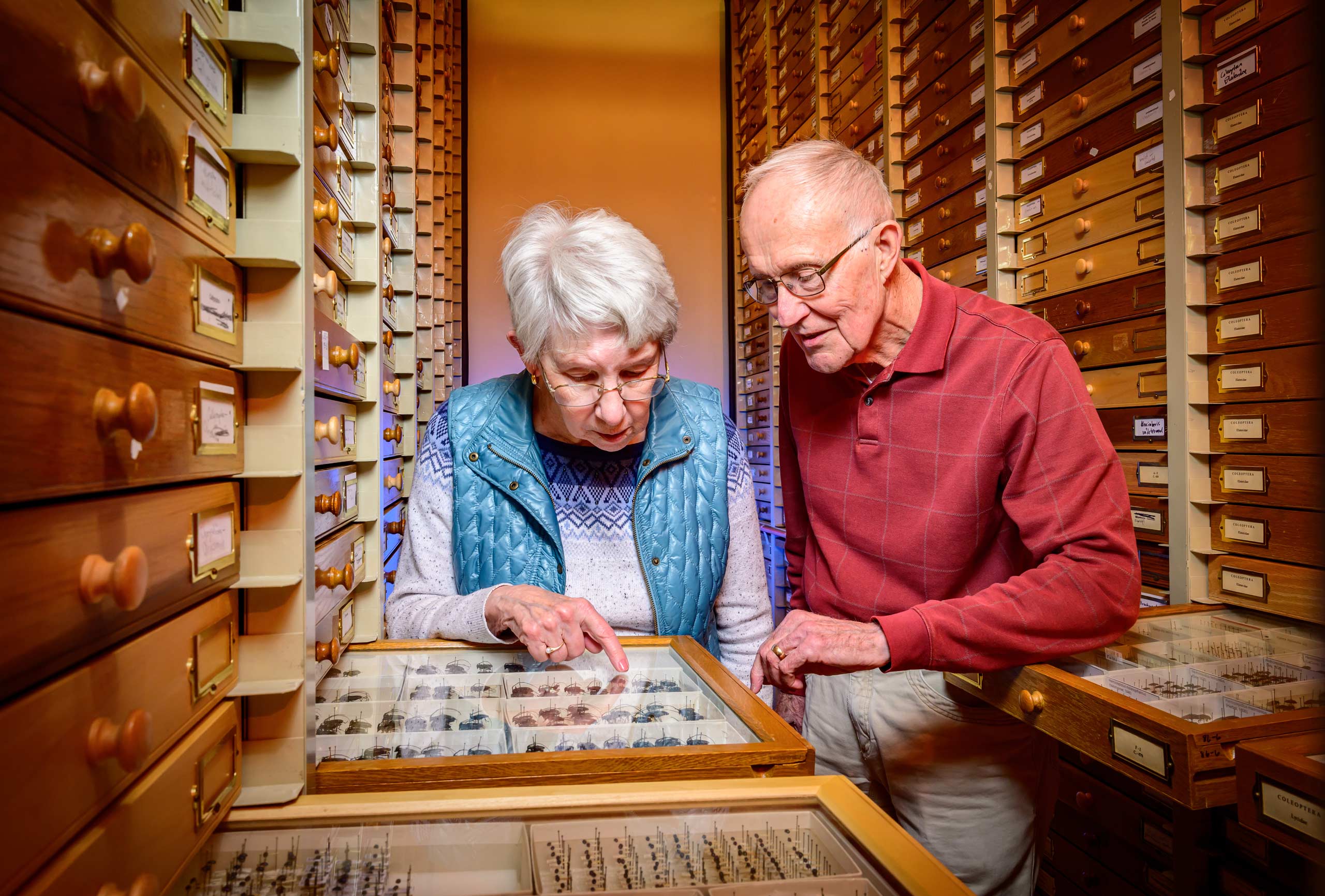
Bill and Cindy Ruesink looking at beetles among stacks of drawers. Image by Fred Zwicky, University of Illinois.
Continuing the Loop
Bill and Cindy headed back to Chesterfield with two more drawers of beetles — “fewer than usual,” Michelle joked.
Michelle sorted the returned boxes and added them to a growing queue. Around her, compactors — mobile shelving units that slide together to maximize storage space — hold stacks of drawers that reach the ceiling.
“This section had the unsorted beetles when he started,” Michelle said, standing between the compactors. “And these are all the leaf beetles,” she added, pointing to more than half of the aisle.
Michelle slid out one drawer of leaf beetles. Inside was a mosaic of white trays with different beetles, along with a new label with the species name in Bill’s handwriting.
Elsewhere in the drawer, smaller labels on aged, browning paper sat under a few pinned beetles in another person’s handwriting. The dates on the labels showed that someone collected these beetles just before the turn of the 20th century — another small reminder of how much history sits inside each drawer.
“We’re fortunate to have Bill,” Michelle said. “Each beetle has a story, and he helped us do that. Their generosity helps us tell the story of every insect in the collection.”
To support scientific research in natural history and public health, consider a gift to the Scientific Collections Fund.
This story was published on Monday, June 22, 2026.